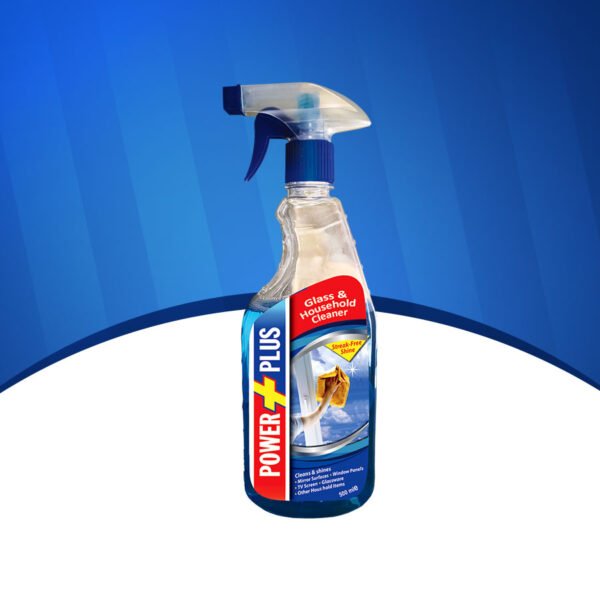
A glass cleaner is a specialized liquid solution designed to clean transparent surfaces—like windows, mirrors, and glass tabletops—without leaving behind streaks, haze, or residue. Unlike all-purpose cleaners, they are formulated to evaporate rapidly (often called “flash-drying”) to ensure maximum clarity.
How It Works
Glass cleaners perform three specific functions in rapid succession:3
-
Lifting: Surfactants break the surface tension, allowing the solution to get under dirt and oily fingerprints.
-
Dissolving: Solvents (like alcohol or ammonia) dissolve greasy residues so they can be wiped away without scrubbing.
-
Flash-Drying: The high alcohol or ammonia content causes the liquid to evaporate almost instantly, preventing the formation of water spots or streaks.
Key Ingredients
| Ingredient |
Purpose |
| Isopropyl Alcohol |
The primary solvent that cuts through grease and ensures fast drying. |
| Ammonia |
A powerful degreaser; however, many modern formulas are “ammonia-free” to be safe for tinted windows and those sensitive to strong odors. |
| Surfactants |
Detergent-like molecules that trap dirt and prevent it from redepositing on the glass. |
| Distilled Water |
Used as a base; distilled water is preferred over tap water because it lacks minerals that cause “hard water” spots. |